
Buying a property through a life annuity (viager) allows for long-term real estate investment while benefiting from a discount linked to the age of the senior who remains in the home. This formula does not increase the new owner’s tax burden but does generate recurring expenses.
Article published in Les Échos on June 11, 2021. By Laurence Boccara
Becoming a property owner with a discount ranging from 20% to 60%: this is the key advantage of a life annuity purchase. This mechanism provides the opportunity to invest in real estate at a reduced price in exchange for a commitment to pay a life annuity to the senior.
When opting for this formula, it is rare to enjoy the property immediately. Its release generally depends on the death of the senior. This significant uncertainty often dampens the enthusiasm of potential buyers, as the timing of the death—whether near or far—can completely change the financial outcome. Despite this, this unique acquisition method appeals to savers wishing to place their liquidity in real estate.
An investment for retirement
Some use this investment to build an estate that will be utilized once they reach retirement. In several (or dozens of) years, the home, having become vacant, can then be rented out to generate rental income or sold with a potential capital gain.
“It is a form of funded retirement,” summarizes Sophie Richard, founding director of the Viagimmo network. “I have several individuals in my clientele, notably expatriates, shopkeepers, and self-employed professionals, who regularly invest in life annuity properties to strengthen their retirement over time. I even see parents buying with their children via family real estate investment companies (SCIs) for inheritance purposes,” says Reza Nakhai, founding partner of the Viva Viager agency.
Life annuity or bare ownership?
As a reminder, the value of a life annuity is determined based on three criteria: the market value of the vacant property, the seller’s age, and their life expectancy. The buyer (débirentier) pays a “bouquet”—a lump sum paid on the day the deed is signed at the notary—and then a monthly life annuity paid to the seller (crédirentier). The negotiation between the buyer and the seller can focus on the balance between these two amounts.
Depending on their financial situation, a buyer may prefer a high bouquet and a low annuity, or vice versa. However, negotiations can go further. “One day, I had the opportunity to successfully negotiate for the buyer the use of a seaside house, which was the seller’s secondary residence, for two weeks every summer,” recalls Sophie Richard. Another solution that has recently gained popularity is opting for a single bouquet. Even if it is larger, this amount allows the total cost to be fixed. In this case, it is no longer referred to as a life annuity but as a bare ownership purchase.
To succeed in a life annuity investment, the buyer should have an age difference of at least 25 years with the senior. This safety margin allows for a calm wait for the completion of the transaction. The most sought-after properties are those occupied by a single person, preferably a man, due to his shorter life expectancy compared to a woman of the same age.
Contrary to popular belief, opting for a life annuity sold by a couple is not such a bad deal. “Buying from a 78-year-old single man allows for a 39% discount, but from a couple with a woman of the same age, it increases to 48%,” explains Sophie Richard.
No deterioration
For an investor, this method of ownership offers multiple advantages. First, the property deteriorates very little, if at all. “It is true that this is a real estate purchase that generates no worries. The risks of property damage are very limited compared to a standard rental where the transient occupant will be less attached to the property,” says Reza Nakhai. Because even if the senior is officially no longer the “owner of the walls,” they will continue to take care of “their home” as before.
Furthermore, since this home generates no rental income, its addition to an estate does not trigger additional income tax. As a sign of the life annuity’s return to favor, new players have recently arrived to dust off this niche market, offering both standard and high-end properties. Last April, the luxury brand John Taylor (Christie’s) launched its life annuity activity. With a wide selection of properties for sale, these specialized real estate brands serve as a good intermediary for those wishing to “do a life annuity.”
These experts will explain the unique rules of this transaction (calculation of the bouquet and annuity, legal terms, obligations), what is negotiable (the balance of bouquet and annuity), and what is not. Because even if they do not occupy the premises, the new owner commits to paying new recurring charges. “The buyer must pay the property tax, non-tenant co-ownership charges, and also major works (facade renovation, roofing, etc.),” specifies Vincent Desmarie, associate director of Barnes Viager.
The health crisis has recently had the effect of expanding the supply, as seniors and their children rediscover the virtues of the life annuity, which allows them to stay at home in good financial and comfort conditions. However, individuals must now be reactive because competition has increased since the arrival, two years ago, of institutional investors managing life annuity funds. “Thanks to growing collection within these collective vehicles, these players have financial firepower. They buy properties quickly, in cash, and without an annuity. And right now, they are sweeping up everything,” indicates Vincent Desmarie.
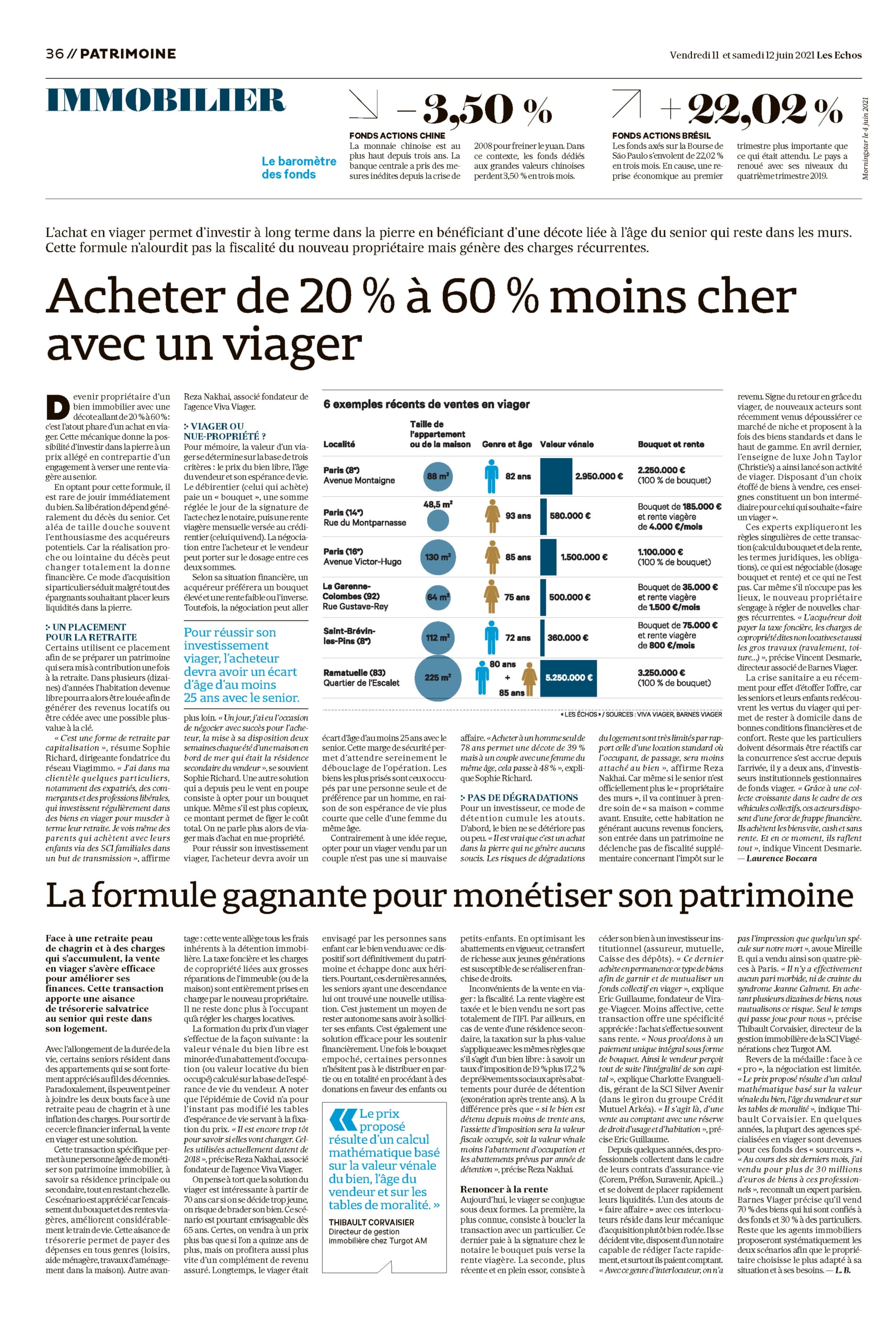
6 Recent Examples of Life Annuity Sales
- Paris 8th: Avenue Montaigne, 88 m2 with a service room, 82-year-old man. Market value: €2,950,000, occupied value: €2,250,000 (100% bouquet)
- Paris 14th: Rue du Montparnasse, 48.5 m2, 93-year-old woman. Market value: €580,000, bouquet of €185,000 and life annuity of €4,000/month
- Paris 16th: Avenue Victor-Hugo, 130 m2, 85-year-old woman. Market value: €1,500,000, occupied value: €1,100,000 (100% bouquet)
- La Garenne-Colombes (92): Rue Gustave-Rey, 64 m2, 75-year-old woman. Market value €500,000, bouquet of €35,000 and life annuity of €1,500/month
- Saint-Brévin-les-Pins (44): 112 m2 house, 72-year-old man, market value €360,000, bouquet of €75,000 and life annuity of €800/month
- Ramatuelle (83): L’Escalet district, 225 m2 villa, 80-year-old man and 85-year-old woman. Market value €5,250,000, occupied value: €3,250,000 (100% bouquet)
Sources: Viva Viager, Barnes Viager