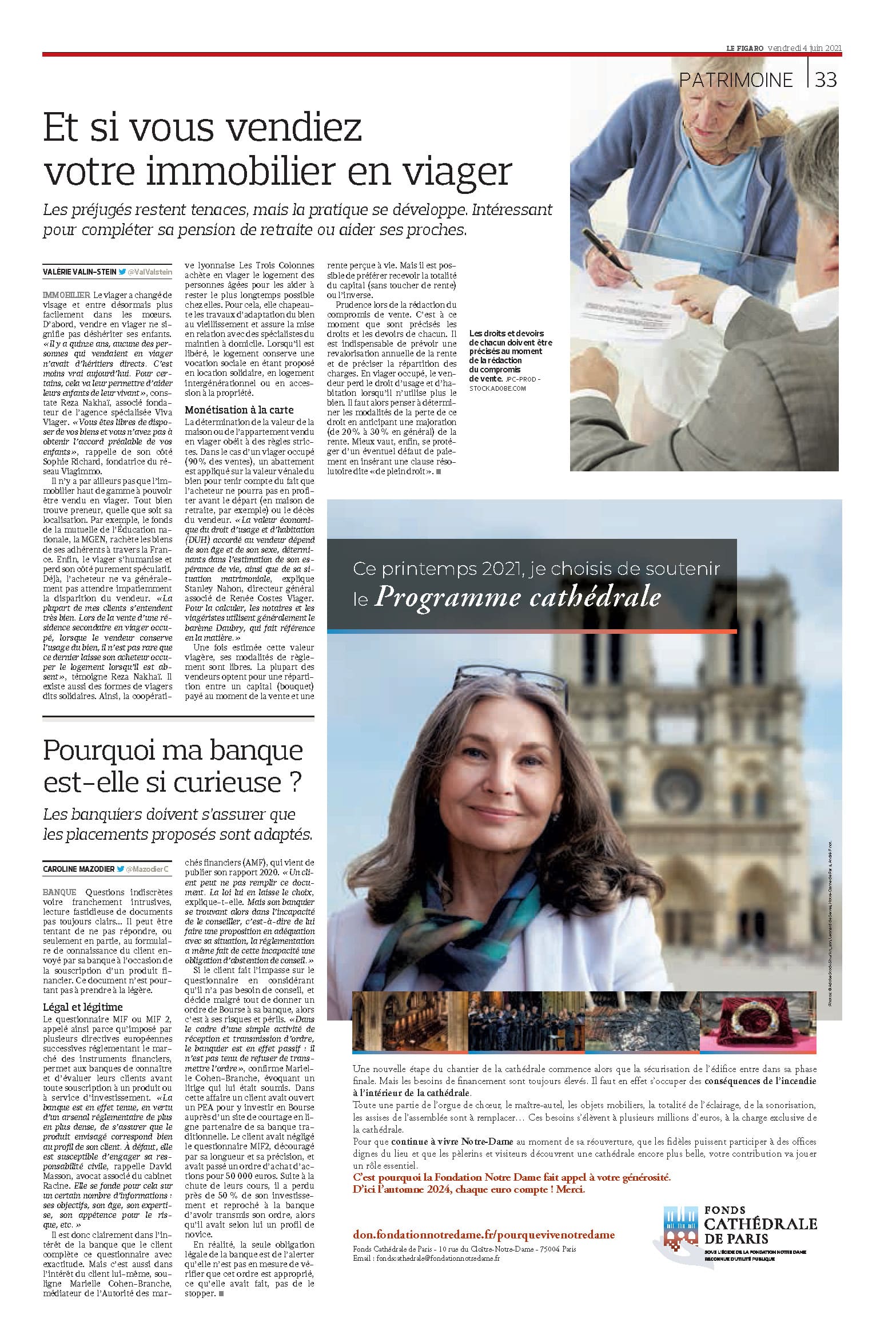
Article published in Le Figaro Patrimoine No. 3, Friday, June 4, 2021. By Valérie Valin-Stein.
Prejudices remain stubborn, but the practice is growing. It is an interesting way to supplement a retirement pension or help loved ones.
The life annuity (viager) has changed its image and is now more easily accepted. First, selling as a life annuity does not mean disinheriting one’s children. “Fifteen years ago, none of the people selling as a life annuity had direct heirs. That is less true today. For some, it will allow them to help their children during their lifetime,” notes Reza Nakhaï, founding partner of the specialized agency Viva Viager. “You are free to dispose of your assets and you do not have to obtain prior agreement from your children,” points out Sophie Richard, founder of the Viagimmo network.
Furthermore, it is not only high-end real estate that can be sold as a life annuity. Every property finds a buyer, regardless of its location. For example, the fund of the national education mutual, MGEN, buys back the properties of its members throughout France. Finally, the life annuity is becoming more human and losing its purely speculative side. For one, the buyer generally does not wait impatiently for the seller’s passing. “Most of my clients get along very well. When selling a secondary residence as an occupied life annuity, where the seller retains the use of the property, it is not uncommon for the latter to let the buyer occupy the accommodation when they are away,”testifies Reza Nakhaï. There are also forms of so-called solidarity life annuities. For instance, the Lyon-based cooperative Les Trois Colonnes buys the homes of elderly people as a life annuity to help them stay in their homes as long as possible. To do this, it oversees the work to adapt the property to aging and ensures the connection with home care specialists. When it is vacated, the housing retains a social vocation by being offered as solidarity rental, intergenerational housing, or for home ownership.
Customized monetization
Determining the value of a house or apartment sold as a life annuity follows strict rules. In the case of an occupied life annuity (90% of sales), a discount is applied to the market value of the property to account for the fact that the buyer will not be able to enjoy it before the seller’s departure (to a retirement home, for example) or death. “The economic value of the right of use and habitation (DUH) granted to the seller depends on their age and gender, which are decisive in estimating their life expectancy, as well as their marital status, explains Stanley Nahon, associate general manager of Renée Costes Viager. To calculate it, notaries and life annuity experts generally use the Daubry scale, which is the reference in the field.”
Once this life annuity value is estimated, its payment terms are flexible. Most sellers opt for a split between a lump sum (bouquet) paid at the time of sale and an annuity received for life. However, it is possible to prefer receiving the entire capital (without receiving an annuity) or vice versa.
Caution is required when drafting the preliminary sales agreement. This is when the rights and duties of each party are specified. It is essential to provide for an annual revaluation of the annuity and to specify the distribution of charges. In an occupied life annuity, the seller loses the right of use and habitation when they no longer use the property. It is then necessary to determine the terms for the loss of this right by anticipating an increase (generally 20% to 30%) in the annuity. Finally, it is better to protect oneself against a possible default in payment by inserting a so-called “automatic” termination clause.