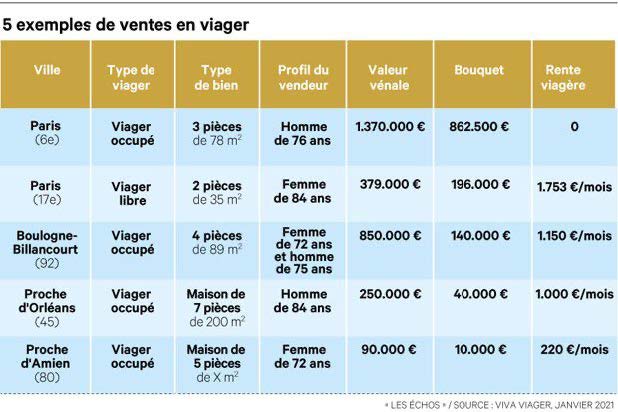

Article published in Les Échos on January 29, 2021. By Laurence Boccara
Monetizing your real estate while continuing to live in it: this is the key advantage of a life annuity sale (viager). With the Covid-19 pandemic, this formula, which encourages seniors to remain in their own homes, is seeing a resurgence of interest.
What if real estate, often the founding pillar of one’s assets, could be used to boost a retirement pension? We tend to forget it, but this (long-standing) solution exists and is called a life annuity sale, or “viager.” Thanks to this unique real estate transaction (representing 2% to 3% of transactions in France), a senior can purchase financial peace of mind and protect themselves from money worries. Even though a deed of sale for the property has been signed at the notary’s office, the retiree does not change their habits. They remain in their home. What changes is that they receive a life annuity paid by the buyer (the annuity debtor).
Previously, they would have received a “bouquet” (a sometimes substantial lump sum) paid on the day the deed was signed. It is only upon their death or departure that the premises will be occupied by the new owner. “With the coronavirus pandemic, the life annuity market is seeing a resurgence of interest. By staying at home, an elderly person is less exposed than if they decide to live in a residence (senior housing, nursing home),” emphasizes Thibault Corvaisier, director of the SCI Via Génération fund at Turgot Asset Management.
For a retiree short on liquidity who has long owned a property that has increased in value over time, this solution allows them to quickly monetize their assets. First, it is the assurance of receiving a regular supplementary income for life to live well in retirement and, in particular, to boost purchasing power (travel, hobbies, home improvements). In later old age, these same sums make it possible to cover expenses related to dependency and necessary for remaining at home.
Furthermore, this scenario allows one to be relieved of the many costs associated with owning real estate. The payment of certain co-ownership charges (major renovation work) and property taxes is, in principle, transferred to the buyer.
For oneself and one’s children
For a long time, life annuities were favored by people without children or those wishing to disinherit them. In recent years, the profile of sellers has expanded. “We are seeing more and more people selling with the agreement of their children,” explains Reza Nakhai, founder of the Viva Viager agency. The reasons for this choice are diverse. Some prefer to sell their property to gain financial autonomy specifically so as not to become a burden to their descendants. Others see it as an opportunity to give a helping hand to younger generations (children, grandchildren, etc.).
While they retain the life annuity, some retirees do not hesitate to make donations to their loved ones, taking advantage of the tax-free allowances provided by law. There is no specific age to sell via life annuity, but before age 65, it is difficult to find an interested buyer. A life annuity sale can be considered for “one head” (with one occupant) or “two heads” (a couple). “With two people, it takes a little longer to find a buyer, but it is entirely possible,” says Reza Nakhai.
A discount
Unlike a traditional transaction, a property offered as a life annuity is always sold at a discount. This price reduction results from the vacant value (or market value) of the home minus an occupancy discount (determined based on a scale that takes into account the age and gender of the seller). Then, this occupied value is distributed as desired between a lump sum (bouquet) and a life annuity, according to the seller’s financial needs.
“Unlike individuals who purchase properties as life annuities, the few real estate funds that buy tend to make single payments in the form of an ‘XXL bouquet,’ without a subsequent annuity,” notes Thibault Corvaisier. When drafting the sales contract, the notary must protect the seller by including termination clauses. For example, the method and frequency of the annuity indexation must be specified, as well as the calculated increase in the event the elderly person moves out. And if the annuity is ever unpaid, a clause
must specify that the sale will be canceled.
Occupied or vacant
Life annuities exist in occupied or vacant versions. The first formula is the most frequent, as it corresponds to a property serving as a primary residence. The retiree has the right of use of the premises; however, this enjoyment is strictly personal. It is therefore impossible for them to rent the said dwelling or install family members there. More rare, the vacant life annuity is likely “to meet the needs of an owner with a rental property,” says Martin Rouveyre, managing director of Apartvie, a real estate agency specializing in the dismemberment of
property ownership.
Taxation of the life annuity
The lump sum (bouquet) of a life annuity sale is not taxed. On the other hand, the life annuities are, as they are considered regular income. They are subject to taxation at the progressive income tax rate. Nevertheless, they benefit from an allowance based on the age of the annuitant at the time of the first annuity payment. This amounts to 70% for a person aged 70 and over (meaning 30% of the annuity is taxed); 60% between 60 and 69; 50% between 50 and 59; and 30% for a person under 50.