

Whether it is to improve retirement, finance home care, or help one’s children, the sale of a primary or secondary residence via life annuity (viager) is progressively becoming socially acceptable. So, why not you?
Article published in Le Particulier n°1182 – June 2021. By Valérie Valin-Stein
It was the decline in the yield of their life insurance that convinced Colette and Paul, a couple in their eighties married for over 50 years, to sell their primary residence in Les Sables-d’Olonne, Vendée, as a life annuity. “As long as our contract yielded around 4% per year, it was enough to supplement our retirement and live peacefully. But the yield gradually dropped, and we had to dip into our capital to maintain our standard of living. Without direct heirs, the idea of a life annuity took root,” explains Paul. “We didn’t know who to turn to
until a specialized agency opened in Les Sables. We thought, rightly so, that they would be well-versed in the local market.” With Colette, they opted for a lump sum payment (also called a “bouquet”) of €50,000, intended to replenish their life insurance, along with a monthly annuity of €1,000. “If I pass away first, thanks to the reversion mechanism, my wife will receive the full annuity,” Paul says reassuringly.
The process was almost identical for Michel who, 3 years ago, sold his vast artist’s studio on the Butte Montmartre in Paris as a life annuity. “This decision was made after a long period of reflection. But I could no longer live on my pension and I was depriving myself of everything. After a while, I got tired of eating starches and canned sardines—I actually still have a few left from that lean period, he recounts with humor. Thanks to the sale of my apartment, I started going out again, traveling a bit to see friends and, above all, having a disabling rare disease, I was able to hire a housekeeper for a few hours a week to help me with domestic tasks.”
Still Too Many Misconceptions
Like Paul, Colette, and Michel, perhaps you wish to improve your daily income, or it is a matter of covering the cost of long-term care or helping your loved ones? Why not monetize your primary or secondary residence?
Today, “inheriting from yourself” is no longer a taboo… or almost! Because some prejudices die hard. Many potential candidates for a life annuity sale still self-censor for fear of how others, especially their children, will perceive them. Fortunately, mindsets seem to be evolving. “Fifteen years ago, none of the people selling via life annuity had direct heirs. That is less true today. For some, monetizing a home will allow them to help their children during their lifetime. It is also a good solution to limit conflicts at the time of succession,” explains Reza Nakhaï, founding partner of the specialized agency Viva Viager. “Thanks to the sale of our apartment, we were able to help our daughter renovate her house, and finance the studies and driver’s licenses of our grandchildren,” say Régine and Pierre, a couple from Nantes, in unison. “You are free to dispose of your assets and you do not have to obtain prior consent from your children. If necessary, explain to them that if you encounter financial difficulties, they will have to help you under the maintenance obligation of articles 205 to 207 of the Civil Code,” opportunely reminds Sophie Richard, founder of the Viagimmo network.
Contrary to another misconception, all properties can be sold as a life annuity, not just those located in Paris or on the French Riviera. Thus, Martine found a buyer for, in her own words, “her little dollhouse” in Le Quesnel, about forty kilometers from Amiens. “It’s a 50 m² cottage that I use for vacations and weekends. I sold it in anticipation of the day when I can no longer drive and go there. At that time, my buyer will have the right to use it, but he will have to pay me a higher monthly annuity than today,”
she tells us. Her case is apparently not isolated; some institutional investors have even specialized in small housing units. “Alongside funds like those of Arkéa or Viagénérations, which acquire properties worth several million euros in Paris or major metropolises, there are others that have developed a real social policy. For example, the MGEN fund [the national education mutual fund, Editor’s note] buys back the properties of its members across France. Other players also aim to promote life annuities in rural areas,” explains Éric Guillaume, president of Virage-Viager and founder of the Vitalimmo Mutualized Life Annuity system.
Beware of Life Annuities Within the Family
Valuation Depends on Age
Are your fears allayed? Now you need to evaluate the sum you can receive from the life annuity sale of your house or apartment. In more than 90% of cases, the seller wishes to continue living in the property; this is known as an “occupied life annuity.” To account for the fact that the buyer (called the debtor) will not be able to enjoy the property before the seller (the annuitant) leaves (to a retirement home, for example) or passes away, a discount is applied to the market value of the property—that is, the price that could be obtained in a conventional sale. “The economic value of the right of use and habitation (DUH) granted to the seller depends on their age and gender, which are determining factors in estimating their life expectancy, as well as their marital status. To calculate it, notaries and life annuity experts generally use the Daubry scale, which is the industry standard. For example, the value of the right of use is set at 40% for a 77-year-old man, 41.6% for an 80-year-old woman, 55.7% for a 70-year-old woman, and 41.8% for a couple consisting of a 77-year-old man and an 80-year-old woman,” details Stanley Nahon, associate general manager of Renée Costes, the leading French network for life annuity transactions. “The life annuity amount will be lower if the seller is a woman, as women have a longer life expectancy than men. The same will apply if the calculation takes into account two people rather than just one, single or widowed, due to the reversibility of the annuity,” adds Sophie Richard.
Customized Monetization
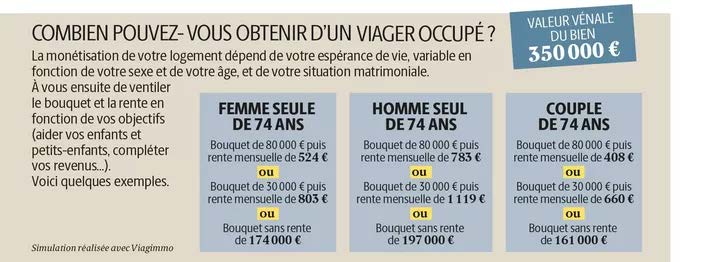
Once you have estimated the life annuity value of your property, you must choose the payment terms for this sum. Most sellers opt for a split between a lump sum (bouquet) paid at the time of sale and an annuity received for life. However, you may prefer to receive the entire capital (without receiving an annuity) or vice versa.
The annual amount of the annuity is calculated by applying an “annuity rate” (also provided by the Daubry scale) to the life annuity value of the property, incorporating the same elements (age, gender, etc.) as those used to determine the DUH. For example, a 78-year-old couple can benefit from an annuity rate of 7.16%. For a property worth €150,000, after applying a right of use and habitation of 52.2%, the couple will receive an annuity of €597 per month if they want to receive a bouquet of €50,000, and €895 per month if they prioritize only the annuity. “If you wish to protect your spouse or supplement your income, a lower bouquet amount and a higher life annuity are preferable. If you plan to help your loved ones, prefer a larger bouquet,” recommends Sophie Richard.
Clauses to Include
Drafting the sales agreement signed between you and your buyer is an important step. This is when you will specify the rights and obligations of each party. If you forget a clause, you will not be able to add it later. If it is poorly drafted, it will be impossible to modify: it will appear in the final deed signed at the notary’s office. “You must systematically provide for an annual indexation of the annuity and specify the distribution of charges between the seller and the buyer. It is customary for the former to pay for maintenance and minor repairs and the latter for major works,” says Bruno Jarry, legal director of Viager Consulting. “If the life annuity covers two people, the reversibility of the entire annuity to the surviving spouse must be recorded,” specifies Sophie Richard.
Furthermore, do not forget that an occupied life annuity sale generally does not grant you a usufruct (which is a real property right), but a simple right of use and habitation. You lose it as soon as you no longer use the property: your buyer can then move in or rent it out. You must determine the terms for the loss of this right by providing, for example, for an increase in the annuity. Finally, you must protect yourself against a potential default in payment. “The best solution is to insert an automatic termination clause. Unlike a standard termination clause, when this one is implemented, the judge has no discretionary power and can only confirm the termination of the contract,” explains Julien Chaton, a notary in Troyes and member of the Groupe Monassier.
The Advantages of a Vacant Life Annuity
Every Party Wins
Contrary to what one might think, a life annuity is not just about big money: the interests of the parties are not necessarily antagonistic. “On one side, we have a seller looking to improve their daily life and, on the other, a buyer who wants to secure their future through real estate,” notes Sophie Richard. She even claims to have seen buyers affected by the passing of their annuitant. A far cry from the clichés conveyed by Pierre Tchernia’s film Le Viager or Maupassant’s Le Petit Fût.